How to Know if Your Home Needs a New Breaker Box
Your breaker box is the single most important piece of electrical equipment in your house, and most homeowners never think about it until something goes wrong. September is one of the smartest months to evaluate it, because the Central Valley is still running air conditioners hard while families start adding space heaters, holiday lighting, and heavier indoor appliance use in the weeks ahead. A breaker box that struggled through a 105 degree August will not magically improve when fall and winter loads arrive. The signs that you need a new breaker box are usually visible long before a failure happens, and they show up as repeat tripping, warm metal, flickering lights, or a panel that simply does not have room for another circuit. Patterson, Modesto, Turlock, and Tracy have thousands of homes built between the 1950s and the 1990s, and many of those still carry original panels rated for a fraction of what a modern household demands. Knowing what to look for gives you the chance to replace equipment on your schedule instead of during an emergency at nine o’clock at night. This guide walks through the physical warning signs, the capacity problems, and the code and safety issues that tell you a breaker box replacement is due.
Warning Signs Your Home Needs a New Breaker Box
The clearest indicators that you need a new breaker box are physical and behavioral, and you can spot most of them without opening anything or touching a single wire. Breakers that trip repeatedly on the same circuit, lights that dim when a large appliance kicks on, and a panel cover that feels warm to the touch are all telling you something. Smell matters too, because hot plastic and scorched insulation produce an odor that does not belong anywhere near your electrical panel. Age is a factor on its own, since panels installed decades ago were built for a household that did not run two refrigerators, a hot tub, a home office, and an EV charger. The frustrating part for homeowners is that these symptoms build slowly, so people adapt to them instead of addressing them. A breaker that trips once every few months eventually trips once a week, and by then the underlying connection or bus damage has been getting worse the entire time.
Breakers That Trip Constantly Are a Warning Sign You Need a New Breaker Box
A circuit breaker is a safety device, and tripping is exactly what it is supposed to do when current exceeds its rating. The problem is not that a breaker trips; the problem is when it trips over and over on a load it used to handle without complaint. That pattern usually points to one of three things: an overloaded circuit carrying more than it was designed for, a breaker that has weakened internally from repeated thermal cycling, or a poor connection at the bus bar generating heat that trips the mechanism early. Breakers do wear out. The bimetallic strip inside responds to heat, and after hundreds of trip cycles it can begin operating below its rated amperage, which makes a perfectly normal load look like an overload. When several breakers in the same panel start behaving this way at once, the panel itself is generally the common factor rather than the individual circuits.
Homeowners often try to solve repeat tripping by swapping in a larger breaker, and that is one of the most dangerous shortcuts in residential electrical work. The breaker is sized to protect the wire behind it, not the appliance in front of it. Putting a 30 amp breaker on a circuit wired with 14 gauge conductors means the wire can reach dangerous temperatures inside your walls long before the breaker ever reacts. That scenario is a genuine fire risk, and it is a violation of the National Electrical Code that any inspector will flag immediately. If a licensed electrician tells you a circuit cannot be upsized without rewiring, that is not upselling. It is the physics of conductor ampacity, and there is no way around it.
There is also the case where tripping reveals a real fault rather than a capacity issue. Ground faults, arc faults, and short circuits all cause breakers to open, and modern AFCI and GFCI breakers are specifically designed to catch conditions that older thermal magnetic breakers ignore completely. If your panel is old enough that it cannot accept AFCI or GFCI breakers, you are missing protection that current code requires in bedrooms, kitchens, bathrooms, laundry areas, and outdoor locations. That limitation alone pushes many Patterson area homes toward panel replacement. Getting an electrician to diagnose the actual cause before anything gets replaced is the right first step, because sometimes the fix is a dedicated circuit and sometimes it is a full panel upgrade.
Heat, Rust, and Burning Smells Signal an Urgent New Breaker Box Need
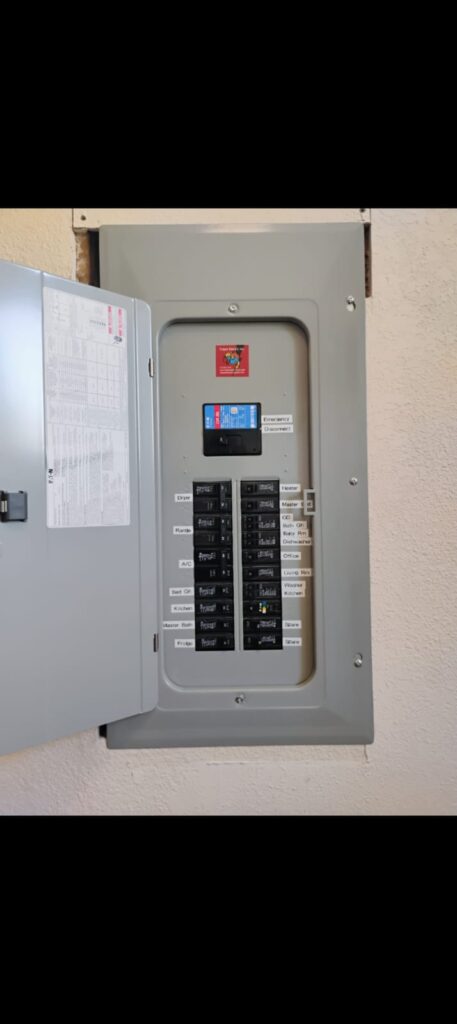
Electrical panels should be cool and dry, and anything else deserves immediate attention. Warmth on the panel cover, on individual breaker handles, or in the wall directly around the enclosure indicates resistance somewhere in the assembly, and resistance in an electrical connection means heat is being produced where it should not be. Loose lugs, corroded bus bars, and breakers that no longer seat tightly all create that condition. Heat compounds itself, because a warm connection oxidizes faster, and oxidation increases resistance further, which produces still more heat. That feedback loop is how a minor loose connection turns into an arcing event over the course of a year or two.
A burning smell near the panel is not something to monitor and revisit later. Melting thermoplastic insulation produces a sharp acrid odor, and by the time you can smell it, conductor temperatures have already gone well past their rated limits. Scorch marks, discoloration on breaker faces, or a sooty film inside the enclosure are physical evidence of arcing that already occurred. Homes in Patterson, Newman, Gustine, and Los Banos that sit near agricultural operations sometimes get an extra dose of dust and ammonia in the air, and both accelerate corrosion on panel components. If you notice any of these conditions, shut off the main breaker if you can do so safely and call an electrician right away rather than waiting for business hours.
Moisture is the other destroyer of breaker boxes, and it shows up more often than people expect. Panels mounted on exterior walls, in garages, or in older homes with roof leaks above them can take in enough humidity to rust the bus bar and the breaker clips. Rust does not conduct well, so every rusted connection point becomes a heat source under load. Once the bus bar is pitted or corroded, there is no repair; the panel has to be replaced, because the bus is an integral part of the enclosure assembly. Frayer Electric handles this situation regularly across the Central Valley, and a proper replacement includes correcting whatever moisture path caused the damage in the first place. Seeing rust, heat, or scorch marks on your panel? Click here for our electrical panel installation service.
Flickering Lights and Dead Outlets Point Toward a New Breaker Box
Lights that dim briefly when the air conditioner starts are usually normal, since compressors draw high inrush current for a fraction of a second. Lights that flicker randomly, dim for extended periods, or brighten and darken in a cycle are a different story entirely. That behavior often traces back to a loose neutral connection, either at the panel or at the service entrance, and a compromised neutral can send unbalanced voltage through your home’s circuits. Appliances hate that condition, and electronics, LED drivers, and variable speed motors are the first things to fail. If flickering affects multiple rooms on different circuits, the panel or service connection is almost always the shared cause.
Dead outlets and half working circuits tell a similar story. When a breaker appears to be on but the circuit is dead, the breaker may have failed internally or lost contact with the bus bar. Aluminum bus bars in particular can develop a poor interface with breaker clips over time, and the connection becomes intermittent long before it fails completely. Homeowners sometimes discover this when they jiggle a breaker and the circuit comes back, which feels like a fix but is actually a serious warning. An intermittent high resistance connection is the exact condition that produces arcing inside a panel.
The diagnostic value here is in the pattern rather than any single symptom. One dead outlet is usually a bad receptacle or a tripped GFCI upstream. Multiple dead outlets across different rooms, combined with flickering and unexplained tripping, points squarely at the panel. A licensed electrician can measure voltage under load at the panel and at the affected circuits to separate a distribution problem from a service problem. That distinction matters, because a service issue may involve the utility while a panel issue is entirely on your side of the meter. Not sure what is causing your flickering lights? Click here for our electrical repair service.
Capacity and Age Problems That Require a New Breaker Box
Beyond visible damage, plenty of homes need a new breaker box simply because the existing one cannot support how the household actually lives. A 60 or 100 amp service was reasonable when a home had one television, a gas range, and a window air conditioner. Today that same house may run central air, an electric dryer, a double oven, a tankless water heater, multiple computers, and an electric vehicle. Panel capacity is a hard limit, and no amount of careful appliance scheduling changes the amperage available at the service. Age brings a second problem, which is the availability and reliability of replacement breakers for discontinued panel lines. When you cannot buy a listed breaker that fits your panel, you have a maintenance dead end that only replacement resolves.
A Full Panel With No Open Slots Means You Need a New Breaker Box
Running out of breaker spaces is the most common reason Central Valley homeowners call about panel replacement, and it usually surfaces during a project. You want a hot tub, a garage subpanel, a new HVAC system, or an EV charger, and the electrician opens the panel to find every slot occupied. Tandem breakers can sometimes create space, but only in panels specifically listed to accept them, and only in the positions the manufacturer designated. Installing tandems where they are not permitted overloads the bus bar rating and violates the panel’s listing, which will not pass inspection. The panel label inside the door states the maximum circuit count, and that number is not a suggestion.
Space is only half the equation, because available amperage matters just as much as available slots. A load calculation performed under Article 220 of the National Electrical Code determines what your service can actually support based on square footage, appliance nameplate ratings, and the specific loads present. A home with a 100 amp service and a full panel may not have the headroom for a 50 amp EV charger even if slots were available. Load management devices can sometimes help by preventing simultaneous operation of large loads, but they are a workaround rather than a solution for a genuinely undersized service. The honest answer in many cases is that the service and panel both need upgrading together.
This is where planning ahead saves real money. If you know you want an EV charger next year, a hot tub the year after, and eventually a heat pump, sizing your new panel and service for all of it now is dramatically cheaper than doing three separate upgrades. A 200 amp service with a 40 space panel gives most Patterson area homes room to grow for decades. The incremental cost between a minimum sized upgrade and a properly sized one is small compared to the cost of returning to redo the work. Planning an EV charger or hot tub? Click here for our electrical panel upgrade service.

Obsolete and Recalled Panels Are a Serious New Breaker Box Concern
Several panel brands installed in American homes from the 1950s through the 1980s have documented safety problems, and homeowners in older Modesto, Stockton, and Turlock neighborhoods still encounter them. Federal Pacific Electric Stab-Lok panels are the most widely discussed, with independent testing showing failure to trip under overload conditions in a meaningful percentage of units. Zinsco and Sylvania Zinsco panels have a separate documented issue where breakers can fuse to the aluminum bus bar and remain energized even in the off position. Challenger panels have had reported problems with breaker to bus connections generating heat. These are not internet rumors; they are conditions electricians see in the field regularly, and many insurance carriers now ask about them directly.
The practical problem with these panels goes beyond the original defect. Manufacturers stopped producing them long ago, so any replacement breaker is either used, refurbished, or a third party product of uncertain listing status. Installing a non-listed breaker in a panel voids the listing of the entire assembly and creates liability for everyone involved. Insurance companies in California have declined coverage or required replacement as a condition of a policy when these panels are present. Homeowners sometimes discover this during a home sale, which is the worst possible time to schedule electrical work.
Even panels without a specific recall history reach the end of their useful life. Manufacturers generally consider a residential panel serviceable for around 25 to 40 years depending on environment and load. Panels in unconditioned garages in the Central Valley heat, or in homes near agricultural operations with airborne dust and chemicals, sit at the shorter end of that range. If your panel dates to the original construction of a home built before 1990, having it evaluated is a reasonable step regardless of whether you have noticed symptoms. An electrical inspection documents the panel’s condition, its remaining slots, and whether the grounding and bonding meet current code.
Modern Electrical Demand Often Requires a New Breaker Box
Household electrical consumption has climbed steadily, and the pace accelerated over the last decade. Electric vehicles alone can add a continuous 40 to 48 amp load for hours at a time, which is more than some older homes were designed to deliver in total. Heat pump water heaters, induction ranges, and heat pump HVAC systems all shift energy use from gas to electricity, and California’s building code direction continues to push that way for new construction and major remodels. Home offices with multiple monitors, networking equipment, and printers add smaller loads that accumulate. Every one of these changes puts demand on a panel that was specified for a different era.
The symptoms of an undersized service can be subtle before they become obvious. Slightly dimmed lights when the AC compressor starts, a dryer that takes longer than it used to, or a main breaker that trips only on the hottest afternoons of the year all suggest the service is near its limit. Voltage drop under heavy load stresses motors and compressors, shortening the life of expensive appliances. Homeowners often replace an air conditioner or refrigerator believing the appliance failed, when the real culprit was chronic undervoltage from an overtaxed service. An electrician can log voltage over time to identify this pattern.
Upgrading the breaker box is frequently the enabling step for everything else a homeowner wants to do. Solar installations require adequate busbar capacity to accept backfeed under the 120 percent rule, and many older panels simply cannot accommodate a system without upgrade. Battery backup, whole house surge protection, and generator interlocks all depend on modern panel hardware. Doing the panel first means the projects that follow go smoothly instead of stalling at the permit stage. Adding solar, a generator, or surge protection? Click here for our whole house surge protection service.
Why You Need a Licensed Electrician for Your New Breaker Box
Breaker box replacement is not a project for a handy homeowner, and it is one of the few electrical jobs where the danger persists even with the main breaker off. The service conductors entering the panel remain energized at full utility voltage until the power company or a licensed electrician disconnects them, and there is no shutoff on your side of that connection. Beyond the safety issue, panel work requires a permit and inspection in Stanislaus, San Joaquin, and Merced counties, and unpermitted work creates problems at resale and with insurance claims. A licensed electrician coordinates the utility disconnect, pulls the permit, performs the load calculation, and makes sure the grounding electrode system meets current code. Frayer Electric handles the entire process so homeowners are not left managing three separate agencies. The result is a panel that is safe, documented, and ready for whatever you add next.
The Right Way to Install a New Breaker Box
A proper panel replacement starts with a load calculation rather than a guess. The electrician documents the square footage, the fixed appliance nameplate ratings, the HVAC equipment, and any planned additions, then sizes the service accordingly under Article 220. That calculation supports the permit application and gives the inspector a basis for approval. Skipping it produces panels that are either undersized on day one or oversized in ways that waste money without adding usable capacity. The calculation takes a professional a short time and prevents expensive mistakes.
The physical work involves scheduling a utility disconnect, removing the old enclosure, installing the new panel and any required service equipment, and transferring every circuit with proper labeling. Grounding and bonding get corrected during this step, which matters because many older installations have grounding that no longer meets code. Two ground rods, a bonded water pipe, and a bonded metallic gas line where required are typical elements. AFCI and GFCI protection is added to the circuits that current code requires, and this alone dramatically improves the safety of an older home.
Inspection closes the job out. The county or city inspector verifies the panel, the grounding electrode system, the conductor sizing, the labeling, and the working clearances around the equipment. Passing inspection produces a record that stays with the property, which is exactly what a buyer’s agent or an insurance underwriter wants to see later. Frayer Electric schedules and meets the inspector so the homeowner does not have to take a day off work. Ready to schedule your panel replacement? Click here for our electrical service upgrade service.
What a New Breaker Box Costs and How to Plan for It
Pricing for a breaker box replacement depends on several concrete variables, and any electrician who quotes a number without seeing the site is guessing. Service size, panel location, whether the meter main needs replacement, the condition of the service entrance conductors, and the amount of grounding work required all move the total. A straight panel swap at the same amperage is the simplest scenario. A full service upgrade from 100 to 200 amps involving a new meter main, mast, and utility coordination is a larger project with more moving parts.
Permit fees and utility coordination are real line items, and homeowners should expect them on any legitimate quote. A bid that comes in far below others often excludes the permit, which is a signal to ask questions rather than a bargain. Unpermitted electrical work in California can complicate a home sale, void insurance coverage after a loss, and require expensive retroactive correction. The permit protects the homeowner more than it protects anyone else.
Frayer Electric provides straightforward quotes with no hidden fees, and we walk through exactly what is included before any work begins. Veteran, senior, and first responder discounts are available, and we apply them at quoting rather than treating them as a negotiation. Scheduling in fall often works better than emergency scheduling in the middle of a July heat wave when demand peaks across the Valley. Planning the work now means it happens on your timeline.
Why Choose Frayer Electric for Your New Breaker Box
Frayer Electric is locally owned and operated out of Patterson, and we serve Modesto, Turlock, Tracy, Manteca, Merced, Los Banos, Stockton, and the surrounding Central Valley communities. Panel replacements and service upgrades are core work for us, not something we take on occasionally. We are licensed and insured, we pull permits on every job that requires one, and we meet the inspector ourselves. That combination gives homeowners a finished job with proper documentation.
We take ethos seriously, which means we tell homeowners when a panel does not need replacing just as readily as when it does. Sometimes the answer is a dedicated circuit, a subpanel, or a repair to a single connection rather than a full replacement. Recommending work that is not necessary would be easy and would also be wrong. Our quotes are straightforward, and the number we give is the number you pay.
We also offer 24/7 emergency service, because panel failures do not schedule themselves conveniently. A burning smell at midnight or a main breaker that will not reset on a Sunday needs a response that day, not on Tuesday. Call Frayer Electric at (510) 861-6247 or email info@frayerelectricinc.com to schedule an evaluation of your breaker box. Need help right now? Click here for our emergency electrician service.