
How to Safely Hang Outdoor Halloween Lights
Halloween decorating season arrives fast in the Central Valley, and outdoor lights are usually the first thing homeowners pull out of the garage. Orange string lights, purple floodlights, glowing pumpkins, and inflatable ghosts all draw power, and most of them end up plugged into a single outdoor outlet that was never meant to carry that much load. Every October, electricians see the same problems repeat themselves: tripped breakers on Halloween night, melted extension cord ends sitting in wet grass, and staples driven straight through the insulation of a light string. The good news is that almost every one of those problems is preventable with an hour of planning and the right supplies. Safe Halloween lighting comes down to using outdoor rated products, protecting every connection from moisture, keeping your circuits below their real capacity, and hanging everything with fasteners that do not pierce the wire. This guide walks through exactly how to do that at your Patterson home, and it explains when the job has moved past what a homeowner should handle alone. Frayer Electric works on outdoor circuits across Stanislaus, San Joaquin, and Merced counties year round, so the advice below reflects what actually fails in the field rather than what looks good on a package label.
What You Need Before You Hang Outdoor Halloween Lights
Preparation matters more than technique when it comes to outdoor Halloween lights. Before a single clip goes on your gutter, you should know which outlets you plan to use, what protection those outlets have, how many watts your display will pull, and which cords are rated to sit outside for a month in dew, rain, and Valley fog. Indoor extension cords and indoor light strings are the single most common mistake, and they are also the most dangerous because their insulation and connectors are not built to shed water. Take fifteen minutes to sort your supplies on the driveway and inspect every cord and string before it goes up, since a damaged strand is far easier to spot on the ground than on a roofline. That short inspection also tells you what you actually need to buy, which saves a second trip to the store on October 30th.
The Right Extension Cords for Outdoor Halloween Lights
Outdoor Halloween lights need cords that are specifically listed for outdoor use, and you can identify them by the letter W molded into the jacket along with a UL listing marked for outdoor conditions. These cords use thicker jackets and moisture resistant compounds that survive sunlight, temperature swings, and standing water in a way that a flat indoor cord simply cannot. Gauge matters just as much as the rating, because a thin cord run a long distance drops voltage and heats up under load. For most Halloween displays, a 16 gauge cord works for runs under 25 feet with light loads, while 14 gauge is the better choice for anything longer or anything powering an inflatable blower. If you are running more than 50 feet, step up to 12 gauge and accept the extra cost, since the wire is doing real work. Always use a three prong cord and plug it into a three prong outlet, because that ground path is what allows a fault to trip the breaker instead of energizing a metal downspout. Never cut off a ground pin to make a plug fit, and never use a cheater adapter on an outdoor circuit.
Cord condition is the other half of the equation, and a cord that looks fine in the box can still be unsafe after three seasons in a bin. Run the entire length through your hands and feel for flat spots, stiff sections, small cuts, and any place where the jacket has separated from the molded plug. Check the prongs for bending, corrosion, and heat discoloration, which shows up as a brown or black ring around the blade. Any cord with exposed copper, a cracked jacket, or a loose plug body goes in the trash, not back on the shelf, because tape is not a repair on an outdoor circuit. Cords that feel warm while your display is running are telling you the load is too high or the gauge is too small, and that warmth is your cue to redistribute the load. Store cords loosely coiled rather than kinked tight, since sharp bends break conductors inside the jacket where you cannot see the damage.
How you route the cord matters as much as which cord you buy. Keep cords out of walkways where trick or treaters will be moving in costumes and masks with limited vision, and never run a cord across a driveway where a tire can crush the conductors. Do not run cords under rugs, doormats, or landscape fabric, because trapped heat has nowhere to go and the covering hides any damage that develops. Keep the connection points elevated and out of low spots that collect sprinkler water, and use a plastic cord connection cover or a weather resistant bag to shield each junction. It is also worth remembering that extension cords are meant for temporary seasonal use, not permanent wiring, so plan to take everything down after the season ends rather than leaving it up until Christmas and then until spring. Homeowners who find themselves stringing four cords together every year usually need another outdoor outlet instead of another cord.
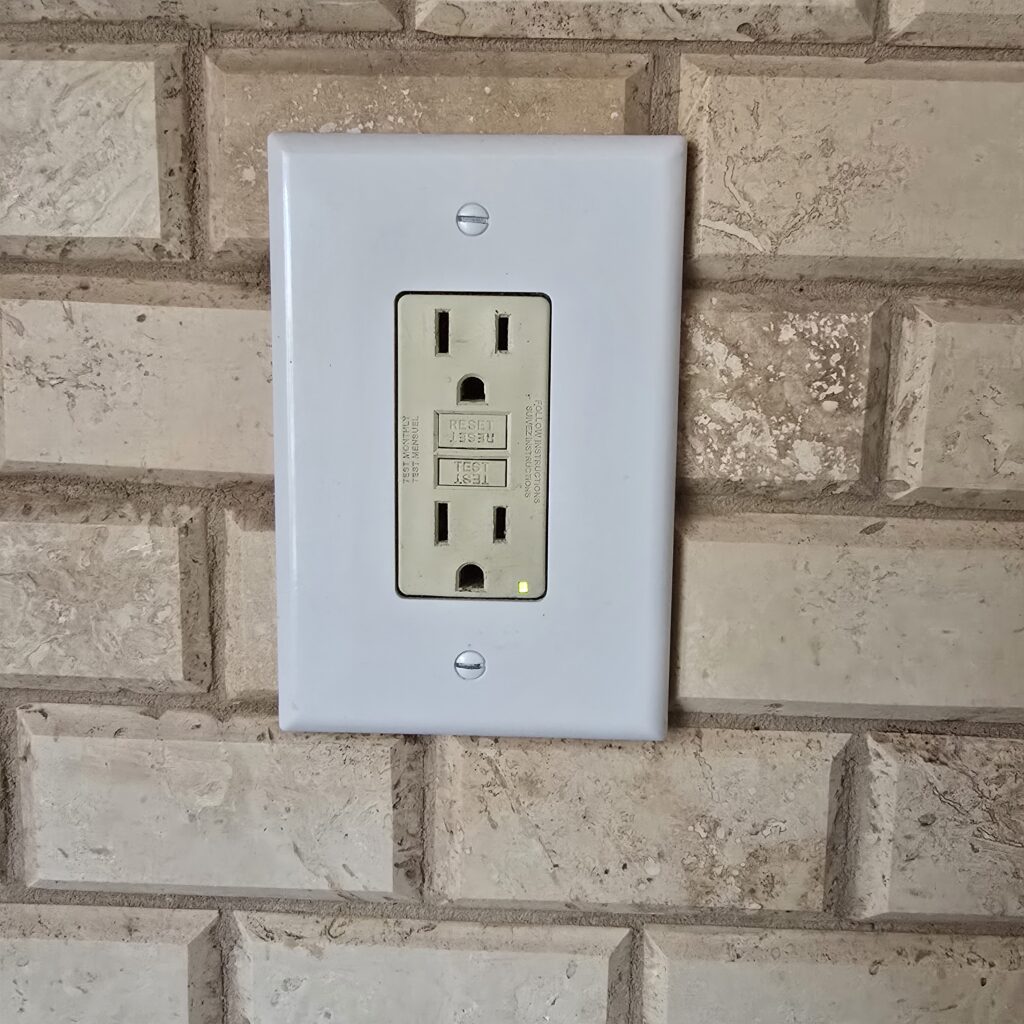
GFCI Outlets and Outdoor Halloween Lights
Every outdoor receptacle at a home is required by the National Electrical Code to have GFCI protection, and that requirement exists precisely because of situations like wet Halloween decorations. A GFCI device monitors the current leaving on the hot conductor and returning on the neutral, and it opens the circuit in a fraction of a second when it detects a small imbalance that suggests current is finding another path. That other path is often a person standing on damp ground, which is why this device is the most important safety feature in your entire Halloween display. Older homes around Patterson, Newman, and Gustine sometimes still have unprotected outdoor outlets from an earlier era, and those need to be updated before you plug anything into them. Testing takes seconds: press the test button, confirm the power shuts off, then press reset and confirm it returns. If the outlet does not trip when tested, or it will not reset, the device has failed and needs replacement.
The outlet cover is the second piece of this system and it gets ignored constantly. An outdoor receptacle that has a cord plugged into it needs what the code calls an in use cover, which is a bubble style enclosure that stays weatherproof with the cord inserted. The old flip lid covers only protect the outlet when nothing is plugged in, so they offer essentially no protection during the exact month your decorations are outside. Bubble covers cost very little and install in a few minutes, and they keep sprinkler spray and rain out of the connection where the arcing risk is highest. Make sure the cord you use fits through the gasket opening without forcing the lid open, since a propped cover defeats the whole purpose. If your outlet box is loose, cracked, or hanging away from the siding, address that before Halloween rather than after.
Nuisance trips during Halloween week usually have a real cause, and it pays to investigate instead of hunting for a workaround. Moisture inside a light string connector, a damaged strand, or an old inflatable with a failing blower motor will all cause a GFCI to trip repeatedly. The correct response is to unplug items one at a time until you identify the culprit, then remove that item from service. The incorrect response, which people try every year, is moving the display to an unprotected indoor outlet by running a cord through a window or door. That approach pinches the cord in the frame, removes the ground fault protection, and creates exactly the hazard the code was written to prevent. Need GFCI protection added to your outdoor outlets before the decorations go up? Click here for our GFCI outlet installation service.
Checking Circuit Capacity Before You Hang Outdoor Halloween Lights
Load math is simple and it prevents most Halloween electrical failures. A standard 15 amp, 120 volt circuit can carry 1,800 watts at its absolute maximum, and the practical working limit for anything running for hours is 80 percent of that, or about 1,440 watts. A 20 amp circuit carries 2,400 watts maximum with a working limit near 1,920 watts. Add up the wattage of everything you plan to plug in, including the items already on that circuit inside the house, and stay under the working limit with room to spare. Light strings list their wattage on a tag near the plug, and inflatable blowers list theirs on the motor housing or in the manual. Remember that the outdoor outlet on your patio may share a circuit with a bathroom, a garage door opener, or a bedroom, so the load is rarely just your decorations.
The type of bulb changes the math dramatically. Traditional C9 incandescent bulbs pull roughly 7 watts each, so a single 25 bulb strand draws about 175 watts and eight strands will push a 15 amp circuit to its limit on their own. LED versions of the same strand often draw less than 5 watts total, which is why LED displays can be forty or fifty times larger on the same circuit. Switching to LED strings is the easiest upgrade available for a growing display, and it also reduces heat at every connection point. Inflatables are the hidden load in most yards, since a blower motor can draw 50 to 150 watts continuously and larger figures draw more. Fog machines and projectors add several hundred watts each and often cycle on and off, which creates surges the circuit has to absorb.
Manufacturer limits on connecting strands end to end exist for a reason, and that reason is the wire gauge inside the light string. Each strand is designed to carry only its own load plus whatever the label allows downstream, so exceeding that limit overheats the first strand in the chain and melts the connector. Incandescent sets typically allow three strands connected together while LED sets often allow twenty or more, and the number is printed on the tag. When you need more length than the limit allows, run a separate extension cord back to the outlet instead of adding another strand. Spread the display across two or three different circuits when possible so one failure does not take down the entire yard. If your breaker trips the moment everything switches on, that is a load problem, not a defective breaker, and repeatedly resetting it is not the answer.
How to Hang Outdoor Halloween Lights Without Damaging Your Home or Wiring
Hanging technique determines both how long your lights last and how safe they are while they are up. The goal is to support the wire without piercing it, without stretching it, and without creating a spot where water can pool at a connection. Roofline and gutter work also introduces ladder safety into the picture, which is where the most serious Halloween decorating injuries actually happen. Take the time to pick the right fastener for each surface, plan your route before you climb, and keep both hands free while you are on the ladder. A display that is hung correctly comes down easily in November and goes back up faster next year.
Safe Fasteners for Hanging Outdoor Halloween Lights
Staples, nails, screws, and tacks have no place anywhere near a light string, because every one of them can penetrate insulation and create a short or a ground fault. Even a staple that misses the conductor compresses the jacket, and that compressed spot becomes a failure point once temperature swings work on it. Plastic light clips are inexpensive, and they come in versions designed for shingles, gutters, fascia, brick, and stucco. Gutter clips hook over the front lip and hold the strand upright so bulbs face outward, while shingle clips slide under the shingle edge without lifting or cracking it. All in one clips handle both surfaces and are worth buying if you are not sure what your roofline needs. Buy more clips than you think you need, spaced roughly every 12 inches, since sagging strands catch wind and pull loose.
Masonry and stucco surfaces need a different approach, and the wrong choice leaves permanent holes in your siding. Adhesive backed hooks rated for outdoor use hold light strings on smooth surfaces and release cleanly when the season ends, though they need a clean dry surface and a full cure time before you load them. Brick clips grip the mortar edge without any drilling and hold surprisingly well. For stucco, avoid anything that requires driving a fastener into the finish, since the resulting holes let water into the wall assembly. Suction based hooks work on glass and vinyl but lose grip in cold weather, so check them every few days. On wood fascia and pergolas, small cup hooks installed once and left in place are the cleanest long term solution for homeowners who decorate every year.
Tension and slack are the details most people get wrong. A strand pulled tight between two points has no room to contract in cold weather and no give when wind pushes it, so it either pops a clip or stresses a connector. Leave a gentle sag between supports and let the wire hang naturally. Create a drip loop below every connection point, meaning the cord dips lower than the plug before rising to the socket, so water follows gravity away from the junction instead of running into it. Keep all connection points at least a few inches off the ground and out of planter beds where irrigation runs. Never hang lights from the cord itself as a support member, and never use the light string to bear the weight of a prop, a sign, or a decoration.
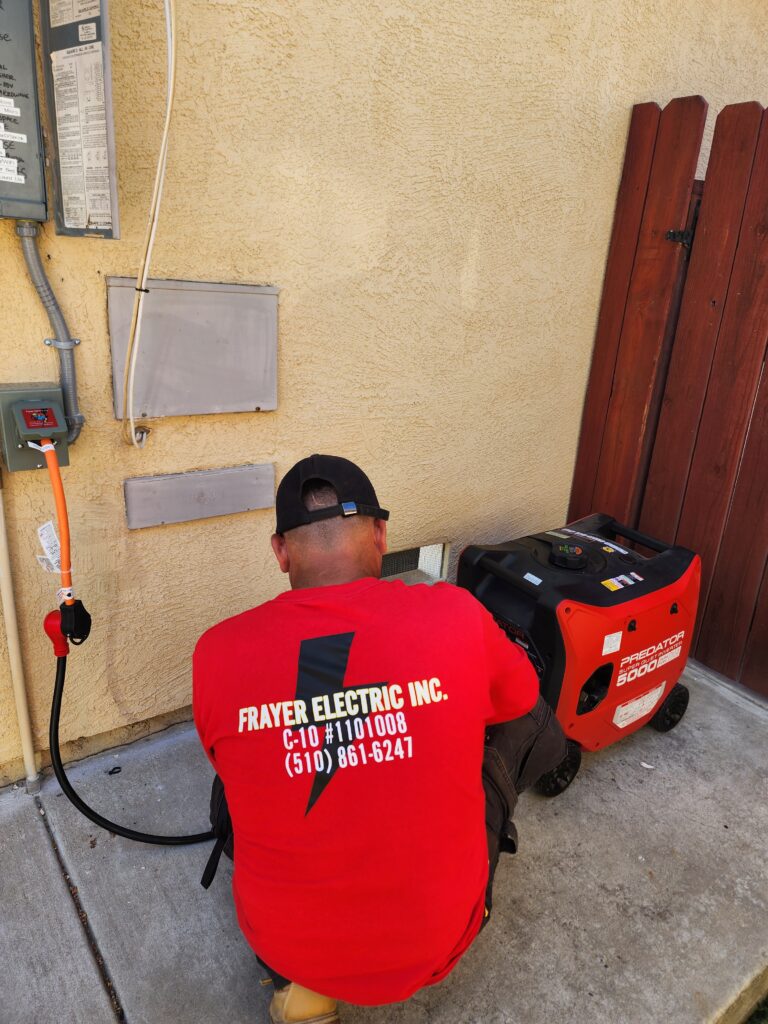
Hanging Outdoor Halloween Lights on Trees, Gutters, and Rooflines
Ladder work causes more Halloween injuries than electricity does, and the rules are simple enough to follow every time. Use a fiberglass ladder rather than aluminum for any work near electrical service equipment, since fiberglass does not conduct. Set the base on firm level ground at the correct angle, roughly one foot out for every four feet of height, and have someone hold the base when possible. Maintain at least 10 feet of clearance from the overhead service drop and any utility line entering your home, and treat every overhead line as energized. Never reach beyond arm’s length from the ladder, and move it instead of stretching. Carry strands in a bag or over your shoulder so both hands stay on the rails while you climb, and do not stand on the top two steps.
Trees add their own considerations because branches move and grow. Wrap strands loosely around trunks and limbs so the wire is never cinched tight against bark, and check any lights that stay up more than a season for wire that is starting to embed. Wind moves branches constantly, so anything you hang in a tree needs slack and needs a connection point that is protected from swaying and rubbing. Avoid running cords through the crotch of a limb where water collects, and keep the lowest connection well above the sprinkler line. In the Central Valley, morning fog leaves everything wet through October, so plan for moisture even when there is no rain in the forecast. Trees near overhead service conductors are off limits entirely for decorating, and that is a job for a professional if it needs to be done at all.
Gutters and rooflines require attention to what is underneath the surface you are clipping to. Loose gutters, soft fascia, and lifted shingles all signal that something needs repair before you add weight and tension to it. Work in one direction along the roofline so your cord run stays organized and your return path to the outlet is short. Plan where each run ends and how it will reach a power source before you start clipping, since discovering you are 15 feet short at the far corner means climbing down and redoing the run. Keep light strings away from vents, flues, and any hot exhaust point on the roof. Take photos of your finished layout so next year’s installation takes half the time.
Weather Protection for Outdoor Halloween Lights
Every product you use outdoors needs to be listed for outdoor use, and that includes items people forget about, such as timers, splitters, remote controls, and smart plugs. An indoor timer plugged into an outdoor cord is a weak point that will fail in the first heavy dew, and it defeats the protection built into everything else. Look for the outdoor rating printed on the housing and check the enclosure for a gasket around the door. Mount timers and controllers on a wall or a post rather than leaving them lying in the grass. Even outdoor rated equipment lasts longer when it is shielded from direct rain and irrigation spray. Take the extra thirty seconds to position it under an eave or inside a weatherproof box.
Connection points are where water causes the most trouble, and they deserve individual attention. Wrap each junction with a cord connection cover, a purpose made plastic shell, or a weather resistant bag secured with a zip tie. Do not use standard electrical tape as your only moisture barrier, since it loosens as temperatures cycle and it traps water once it does. Elevate every junction off the ground on a stake, a brick, or a hook so it never sits in a puddle. Turn off your irrigation zones that spray the decorated areas for the month, since sprinklers hit connection points far more often than rain does around here. After any storm or heavy fog, walk the display and check that covers are still seated and cords have not shifted.
Timing and duration matter for safety as well as your power bill. Put the entire display on an outdoor rated timer or a photocell so lights are not running all night unattended, and set them to shut off after trick or treating ends. Unplug the display during heavy wind or rain rather than leaving it energized while cords are moving around. Inspect the whole run every few days for damage from animals, kids, wind, and yard equipment, since a chewed cord is easy to miss until it faults. Plan to take everything down within a reasonable window after the holiday, since seasonal decorative wiring is intended as a temporary installation and not a permanent one. Store strands wound on a reel or a piece of cardboard so they come out of the box next year without kinks. If a strand shows any damage during teardown, retire it then instead of discovering the problem next October.
Why You Should Call a Licensed Electrician for Outdoor Halloween Lights
Most Halloween decorating stays firmly in do it yourself territory, and it should. The line gets crossed when the work involves adding outlets, modifying circuits, working near the service drop, or troubleshooting a breaker that will not hold. Those situations involve permanent wiring and code requirements, and they carry real consequences when they are handled wrong. A licensed electrician also spots the conditions that a homeowner has no reason to recognize, such as an undersized circuit, a failing panel, or a missing ground. Frayer Electric handles this work throughout Patterson, Modesto, Turlock, Tracy, Manteca, and the surrounding Central Valley, and we do it with straightforward quotes and no hidden fees. Getting it done right the first time is the entire point.
Warning Signs Your Outdoor Halloween Lights Need an Electrician
A breaker that trips every time you plug in your display is not a defective breaker, it is a circuit telling you it is overloaded or faulted. Resetting it repeatedly forces a device to do its job over and over, and eventually that device fails in the wrong direction. If you have already reduced the load and the breaker still trips, the problem is in the wiring or the panel and needs a professional. Warm outlet covers, buzzing sounds, and a burning smell near an outdoor receptacle all call for an immediate stop and a phone call. Discolored or scorched outlet faces indicate arcing that has already occurred.
Lights that dim or flicker when a blower motor starts point to a voltage drop problem, which can come from an undersized conductor, a long run, or a loose connection somewhere upstream. Loose connections generate heat, and heat inside a wall is how electrical fires start. Any outdoor outlet that has no GFCI protection needs to be updated regardless of what you plan to plug into it. Outlets that feel loose in the box, wobble when you insert a plug, or have paint sealing the cover are all worth addressing before the season. These are small repairs when caught early and expensive ones when ignored.
Some homes simply do not have enough outdoor capacity for a modern display, and no amount of cord management fixes that. If you are running four extension cords out of a garage and through a side yard every year, the underlying issue is missing outdoor outlets. An electrician can evaluate the existing panel, determine available capacity, and add properly protected exterior receptacles where you actually need them. That evaluation also catches other issues, such as an undersized panel or missing grounding, that affect the whole house year round. Concerned about the condition of your home’s wiring before the holidays? Click here for our electrical inspection service.

Permanent Outdoor Outlets Make Halloween Lights Easier Every Year
Adding dedicated outdoor outlets is the single best investment for anyone who decorates for Halloween and Christmas both. A properly installed exterior receptacle with GFCI protection and an in use cover eliminates the cord tangle, removes the trip hazards from your walkways, and gives you a safe connection point right where the display lives. Placement is worth planning carefully, since outlets near the front corners of the house, along the driveway, and at the back patio cover almost every decorating scenario. Many homeowners add a switched outlet near the roofline so holiday lights can be controlled from inside the house. That single feature saves a ladder trip every single night.
Permanent outdoor lighting is the next step up, and it serves the house all year rather than one month of it. Landscape lighting, path lighting, and soffit mounted fixtures improve security and curb appeal while giving your seasonal decorations a foundation to build on. These systems run on properly installed circuits with weatherproof fittings and buried conductors, so there is nothing to take down and nothing to store. Homeowners who install permanent lighting typically use far less temporary decoration each season because the base illumination is already there. Planning a permanent solution before the holidays? Click here for our outdoor lighting installation service.
Larger displays sometimes need more than another outlet. Homes with older panels, limited available circuits, or a service that was sized for a smaller load may need a panel evaluation before adding anything. That is common in older neighborhoods across Ceres, Riverbank, Escalon, and Oakdale, where original panels were never designed for today’s electrical demand. Upgrading the panel or adding a dedicated circuit solves the problem permanently rather than working around it each December. It also supports everything else a modern household runs, from EV chargers to air conditioning. Addressing capacity once is far cheaper than repeatedly repairing the symptoms.
Why Choose Frayer Electric for Outdoor Halloween Lights and Outdoor Electrical Work
Frayer Electric is locally owned and operated, licensed and insured, and based right here at 432 Peregrine Dr in Patterson. We serve Patterson and the surrounding Central Valley, including Modesto, Turlock, Tracy, Manteca, Merced, Los Banos, Stockton, Ripon, and the smaller communities in between. Our quotes are straightforward with no hidden fees, so you know the cost before work begins. We offer discounts for veterans, seniors, and first responders because those customers have earned them. Every job gets done right the first time, which is the standard we hold ourselves to.
Outdoor electrical work has details that matter, and we handle all of them. Correct GFCI protection, proper in use covers, appropriately sized conductors, weatherproof fittings, and code compliant installation are not upgrades in our work, they are the baseline. We explain what we are doing and why, so you understand your own electrical system better when we leave. If something in your display is failing and you cannot find the cause, we can trace it. That kind of troubleshooting saves homeowners hours of frustration.
Electrical problems do not wait for business hours, and neither do we. Frayer Electric offers 24/7 emergency service, so a fault on Halloween night does not have to ruin the evening or become a safety risk. Call us at (510) 861-6247 or email info@frayerelectricinc.com to schedule work or ask a question. Have an urgent electrical problem right now? Click here for our emergency electrician service. We are committed to getting it done right every time, for every customer, in every season.