
Why Kitchen Circuits Struggle During Holiday Cooking
Holiday cooking asks more of a kitchen in one afternoon than the room usually handles in an entire month. The oven runs for hours at a stretch, a countertop roaster or second oven joins the effort, and the microwave, coffee maker, electric griddle, and slow cooker all draw power from wiring that was never sized for that kind of day. Most kitchens across Patterson and the surrounding Central Valley were built around a far lighter workload, especially in homes framed before the 1990s. When a breaker trips right as the side dishes come together, the wiring is not failing at random; it is doing precisely the job it was designed to do, which is to shut off power before conductors overheat. Understanding why kitchen circuits struggle during holiday cooking helps you plan the meal around your home’s real capacity instead of guessing. Some of the trouble comes down to load management that any homeowner can handle with a little forethought. The rest points to panels, breakers, outlets, or branch wiring that have quietly reached the end of their useful service life and need a licensed electrician.
What Causes Kitchen Circuits to Overload During Holiday Cooking
A kitchen circuit trips because the total current flowing through it exceeds what the breaker and wire are rated to carry safely. A standard 20 amp small appliance circuit delivers roughly 2,400 watts at full capacity, and the National Electrical Code expects continuous loads to stay near 80 percent of that number, which lands closer to 1,920 watts in practice. A single countertop roaster can consume 1,500 watts on its own, and an electric griddle or air fryer sits in the same range. Add a coffee maker and a stand mixer to the same run of outlets and you have already crossed the line. Older kitchens frequently share one or two circuits across every countertop receptacle, the refrigerator, and sometimes the dining room. Newer kitchens spread that demand across several dedicated circuits, which is why identical appliances behave differently in different houses. The difference between a smooth holiday meal and a dark kitchen usually comes down to how much branch circuit capacity was installed behind the drywall years ago.
How Overloaded Kitchen Circuits Trip Breakers During Holiday Cooking
Circuit breakers protect wire, not appliances, and that distinction explains most of what happens on a busy cooking day. Inside a standard thermal magnetic breaker sits a bimetallic strip that bends as current heats it, and when the current stays above the rating long enough, that strip trips the mechanism and opens the circuit. This response is deliberately slow, so a brief surge from a motor starting up will not cut power, while a sustained overload from three heating appliances will. Heating elements are the real problem during the holidays because they pull steady, heavy current the entire time they run rather than cycling on and off like a refrigerator compressor. A roaster oven, a warming tray, and a coffee maker running together on one 20 amp circuit will push past capacity within minutes. The breaker holds for a while, heats up, and then lets go, usually at the least convenient point in the schedule. That trip is protection working correctly, and repeatedly resetting it without reducing the load simply pushes the same heat back into the wiring.
The location of the overload matters as much as the size of it. Heat builds fastest at connection points, so a loose terminal screw behind an outlet or a backstabbed receptacle with a weak spring contact will run far hotter than the wire itself. Homes wired with aluminum branch circuits in the mid 1960s through the mid 1970s face an additional risk, since aluminum expands and contracts more than copper and works its connections loose over decades. Under a light load, none of this announces itself. Under a holiday load, those same connections can reach temperatures that scorch insulation and discolor the outlet face. Warmth at a receptacle, a faint plastic smell, or a cover plate that looks slightly browned all signal a connection problem rather than a simple overload. Those symptoms deserve immediate attention because the breaker will not necessarily trip on a loose connection. Current can stay within the rating while heat accumulates at a single point.
Frequency tells you how serious the situation has become. A breaker that trips once during the largest meal of the year is telling you to redistribute appliances, and that is easy enough to fix. A breaker that trips every few weeks under ordinary use is telling you the circuit is undersized for how the kitchen is actually used, and the fix involves adding capacity. A breaker that trips immediately upon reset, or one that feels warm to the touch on the panel face, points to a fault or a failing breaker rather than a load issue. Breakers wear out, and after enough thermal cycles the internal mechanism becomes unreliable, sometimes tripping early and sometimes failing to trip at all. Certain older panel brands, including Federal Pacific Stab Lok and Zinsco equipment, have well documented failure histories and are worth evaluating regardless of symptoms. Need a breaker that keeps tripping looked at before the holidays? Click here for our circuit breaker repair service.

Why Older Kitchen Circuits Cannot Handle Modern Holiday Appliances
Kitchen wiring standards have changed substantially over the past several decades, and a house reflects the code that existed on the day it was built. The requirement for two or more 20 amp small appliance branch circuits serving countertop receptacles arrived in the 1959 code cycle, but plenty of homes still carry original wiring that predates or ignores it. Kitchens from the 1950s and 1960s were often served by a single 15 amp circuit shared with lighting, because the appliances of that era amounted to a toaster, a percolator, and a mixer. A modern kitchen carries an entirely different inventory. Countertop appliances have multiplied, and nearly all of the new ones convert electricity directly into heat, which is the most current intensive thing an appliance can do. The wiring did not change; the demand did. That mismatch is the single most common reason kitchen circuits struggle during holiday cooking in older Central Valley homes.
Dedicated circuits are the other half of the story. Current code expects the dishwasher, the garbage disposal, the microwave, and the refrigerator to each have their own supply rather than sharing countertop circuits. When a builder or a previous owner skipped that step, those appliances borrow capacity from the same receptacles you plan to use for the roaster and the griddle. A dishwasher running its heated dry cycle draws well over 1,000 watts, and a built in microwave adds 1,200 to 1,500 watts more. Combine either one with a countertop heating appliance and the circuit is finished before you have plugged in anything else. Homeowners often discover these shared arrangements only when a trip in one part of the kitchen kills power somewhere unexpected. Mapping which outlets belong to which breaker takes an afternoon and reveals a great deal about what your kitchen can realistically support.
Service capacity at the panel sets the ceiling on everything downstream. Many Patterson area homes built before the 1980s still run on 100 amp service, and some older properties operate on 60 amp panels that were adequate when the house had one wall oven and no air conditioning. Adding kitchen circuits to a panel that is already full, or already loaded near its calculated capacity, is not a matter of finding an empty slot. A proper load calculation accounts for general lighting, small appliance circuits, the range, the dryer, HVAC equipment, and any EV charger before determining what headroom remains. Tandem breakers and subpanels can sometimes create space, but they do not increase the amperage the utility feeds into the house. When the calculation shows the service is maxed out, an upgrade to 200 amp service becomes the practical starting point for any meaningful kitchen improvement. If your panel is out of room or your home still runs on 100 amp service, click here for our electrical panel upgrade service.
Warning Signs Your Kitchen Circuits Are Failing Before Holiday Cooking Starts
Kitchen circuits rarely fail without notice, and the early signals are easy to dismiss as quirks of an older house. Lights that dim noticeably when the refrigerator compressor kicks on indicate voltage drop, which suggests either an undersized conductor, a long circuit run, or a loose connection somewhere in the path. A slight flicker when a motor starts is normal; a visible dip that lasts a second or more is not. Outlets that no longer grip a plug firmly have worn contacts, and loose contacts generate heat under load. Receptacles that feel warm through the cover plate warrant investigation the same week you notice them. Buzzing or crackling from a switch, an outlet, or the panel itself points to arcing, which is a fire risk rather than an inconvenience. Any burning smell near electrical equipment justifies shutting off the circuit and calling an electrician immediately.
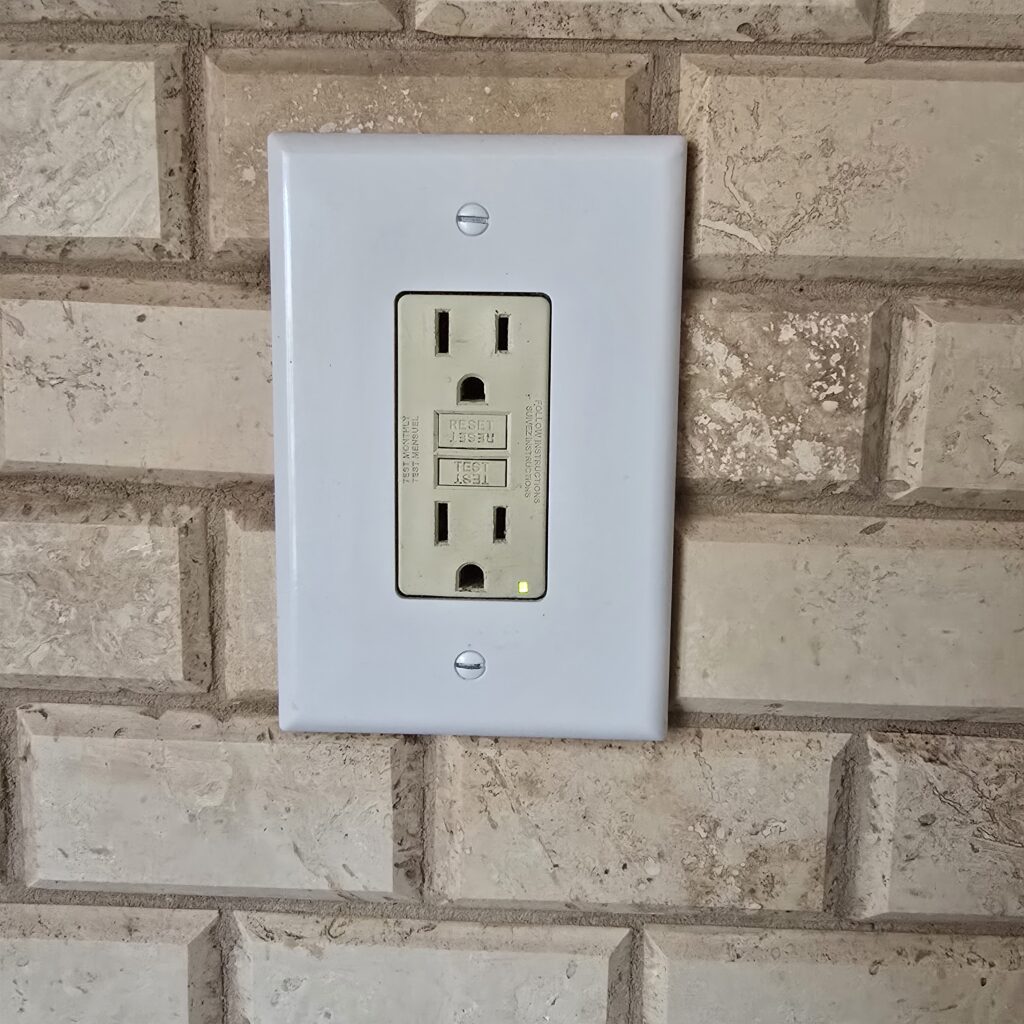
Ground fault protection deserves its own review before a heavy cooking day. Code has required GFCI protection at kitchen countertop receptacles for decades, and the 2020 code cycle expanded that requirement to essentially all kitchen receptacles, including those serving the dishwasher and the range. GFCI devices monitor the difference between current leaving on the hot conductor and returning on the neutral, and they cut power within milliseconds when that difference reaches roughly five milliamps. That level of sensitivity is what makes them effective near sinks and wet countertops. It also means an aging appliance with degraded insulation can trip the device repeatedly, which people often misread as a defective outlet. Pressing the test and reset buttons on each GFCI once a month confirms the device still functions, and a GFCI that will not reset with nothing plugged in has failed and needs replacement.
Arc fault protection is now required in kitchens as well, and the two technologies solve different problems. An AFCI breaker looks for the electrical signature of an arcing fault, the kind produced by a damaged cord, a nail driven through a cable, or a deteriorating splice inside a junction box. Homes built or substantially rewired since the 2014 code cycle generally have this protection on kitchen branch circuits, while older homes typically do not. Nuisance trips do occur, particularly with certain vacuum motors and older appliances, but a repeated AFCI trip should be investigated rather than tolerated. Tracking down the specific cord or connection causing it usually resolves the issue permanently. A full inspection before the holiday season identifies these problems while there is still time to correct them without disrupting a meal. Want a professional review of your kitchen wiring? Click here for our electrical inspection service.
How to Prevent Kitchen Circuit Overloads During Holiday Cooking
Preventing overloads comes down to two strategies that work together: managing what you plug in, and increasing what the kitchen can supply. Load management costs nothing and produces immediate results, especially on a single large cooking day. It requires knowing which outlets share a breaker and roughly how much each appliance draws, information you can gather in about an hour with a notepad and the panel directory. Capacity improvements require an electrician and a permit, but they solve the problem permanently rather than working around it every year. Most kitchens benefit from a combination of the two, since even a well wired kitchen has limits. Homeowners who plan ahead avoid the scramble that comes with a dark countertop and a house full of guests. The best time to sort this out is well before the cooking season, when scheduling is flexible and parts are readily available.
Spreading Appliance Load to Prevent Kitchen Circuit Overloads
Start by building a simple map of your kitchen circuits, because guessing leads to exactly the failure you are trying to avoid. Turn off one breaker at a time and note which outlets, lights, and appliances lose power, then label the panel directory accurately. You will often discover that the outlets on opposite sides of the kitchen share a circuit while two adjacent outlets sit on separate ones, which is the reverse of what most people assume. Pay particular attention to split receptacles, where the top and bottom halves are fed by different circuits, since these were a common solution in kitchens built during the 1980s and 1990s. Note also which circuits extend beyond the kitchen into the dining room or a hallway. With an accurate map in hand, you can distribute heating appliances across separate circuits instead of clustering them on one convenient countertop. This single step resolves the majority of holiday tripping problems in kitchens that are otherwise wired correctly.
Next, learn the actual draw of the appliances you plan to run simultaneously. Nearly every appliance lists its wattage on a label near the cord or on the bottom of the housing, and dividing that number by 120 gives you amps. A 1,500 watt roaster draws 12.5 amps, which occupies most of a 20 amp circuit by itself once you account for the continuous load allowance. Two such appliances on one circuit will trip it reliably, so plan for one heavy heating appliance per circuit and fill in around it with low draw items like a stand mixer or a phone charger. The refrigerator deserves protection from this juggling entirely, because a tripped breaker that goes unnoticed for several hours puts food at risk. Slow cookers are the friendliest option on a crowded day, since most draw under 300 watts and can share space comfortably. Sequencing helps too; running the coffee maker before the griddle rather than alongside it keeps peak demand lower.
Extension cords and power strips deserve a firm warning, because they cause more holiday kitchen problems than any other single factor. A power strip does not create additional capacity; it simply provides more places to overload the same circuit. Light gauge extension cords, particularly the 16 gauge variety sold for lamps, cannot safely carry the current a roaster or griddle demands, and they heat up along their entire length under that load. Cords run under rugs or through doorways suffer insulation damage that leads to arcing faults. If you must use a cord for a countertop appliance, use a heavy 12 gauge cord rated for the appliance and keep it as short as possible. Better still, plug heating appliances directly into wall receptacles and rearrange the workflow around the outlets you have. Adding permanent outlets is inexpensive compared to the damage a failed cord can cause.

Kitchen Circuit Upgrades That Prevent Holiday Cooking Overloads
Adding dedicated circuits is the most direct fix for a kitchen that runs out of capacity every year. An electrician can typically run new 20 amp circuits from the panel to strategic countertop locations, giving you outlets that no other appliance competes for. In homes with accessible attics, crawlspaces, or unfinished basements, this work goes quickly and requires minimal drywall repair. Kitchens on slab foundations with finished ceilings above take more effort, though careful routing usually keeps patching limited. Each new circuit requires GFCI protection at the receptacle or the breaker, along with AFCI protection under current code, and a permit and inspection confirm the work meets requirements. Two additional dedicated circuits transform how a kitchen handles a heavy cooking day. The investment pays off every time you host, and it improves the home’s value and inspection profile as well.
Panel capacity often determines what is possible, so a load calculation should come before any decision about new circuits. An electrician evaluates the existing service size, counts the actual load, and identifies available spaces in the enclosure. Panels that are physically full can sometimes accept tandem breakers, though many modern panels and all AFCI or GFCI requirements limit that option. A subpanel installed near the kitchen provides room for several new circuits while keeping the wire runs short, which reduces voltage drop and material cost. When the service itself is undersized, upgrading to 200 amps addresses the kitchen along with future needs like an EV charger, a heat pump, or an expanded HVAC system. Doing the panel work once, correctly, avoids paying twice for the same access and permitting.
Receptacle and device upgrades round out the improvement list and cost far less than new circuits. Replacing worn receptacles restores firm contact and eliminates the heat that loose blades generate, and modern tamper resistant devices are required in most residential locations anyway. Swapping backstabbed connections for screw terminated ones creates a far more reliable joint that will not loosen with thermal cycling. Where GFCI devices are missing or nonfunctional, installing current models brings the kitchen up to code and provides genuine shock protection at wet locations. Adding outlets along an island or a previously bare stretch of counter gives you somewhere to plug in without stringing cords across walking paths. Under cabinet lighting on its own circuit frees countertop receptacles for appliances rather than task lights. These smaller improvements often accompany larger work at little additional labor cost.
Kitchen Circuit Safety Checks to Complete Before Holiday Cooking Season
A methodical walkthrough a few weeks before the cooking season catches problems while solutions are still easy. Begin at the panel, checking that the directory is legible and accurate, that no breaker feels warm, and that there is no rust, moisture staining, or burnt odor inside the enclosure. Leave the dead front cover in place unless you are qualified to work inside an energized panel, because exposed bus bars carry lethal current even with breakers switched off. Move to the kitchen and test every GFCI device using the test and reset buttons, confirming that power actually drops at the protected outlets. Inspect each receptacle face for discoloration, cracks, or a loose fit when you insert a plug. Check appliance cords for cuts, kinks, exposed conductors, or plugs that feel hot after use.
Pay attention to how the kitchen behaves during ordinary use in the weeks leading up to the holidays. Note any lights that dim when the disposal runs, any outlet that stops working intermittently, and any breaker that has tripped without an obvious cause. Intermittent outlets almost always indicate a loose connection at a device or a wire nut, and that condition tends to worsen under heavier load. Write down what you observe rather than relying on memory, since these details help an electrician diagnose the issue quickly. If the range or wall oven has its own breaker, verify that it holds during a long baking session at high temperature. A 240 volt range circuit that trips under sustained load may have a failing breaker, a loose lug, or a damaged conductor.
Finally, take stock of what you actually plan to cook and where each appliance will live during the meal. Physically plugging in the roaster, the griddle, and the warmer a week ahead of time and running them together for twenty minutes reveals capacity problems while there is still time to act. This dry run costs almost nothing and eliminates the guesswork entirely. If a breaker trips during the test, you know exactly which combination fails and can either rearrange or call for additional capacity. Keep a flashlight near the panel and confirm you can reach it easily, since a tripped breaker in a crowded garage at dinnertime is an unnecessary frustration. Preparation of this kind turns a potential emergency into a nonevent.
Why You Need a Licensed Electrician for Kitchen Circuit Problems
Kitchen circuits sit at the intersection of heavy load, water, and constant daily use, which makes them one of the least forgiving areas of a home’s electrical system. Code requirements for kitchens are stricter than for most other rooms precisely because the consequences of a mistake are more severe. A licensed electrician brings the load calculations, the code knowledge, and the permitting relationship that turn a repair into a lasting solution. Guesswork with breaker sizes, conductor gauges, or protection devices can create a hazard that hides for years before it announces itself. Professional work also carries documentation that matters when you sell the home or file an insurance claim. Frayer Electric handles kitchen circuit work throughout Patterson, Modesto, Turlock, Tracy, Manteca, and the surrounding Central Valley.
What a Licensed Electrician Does for Struggling Kitchen Circuits
Diagnosis comes first, and it involves more than swapping a breaker and hoping. An electrician traces the circuit from the panel to each device, measures voltage under load, and identifies where resistance and heat are building. Thermal imaging and clamp meters reveal problems that a visual inspection cannot, including loose lugs and overloaded conductors. That diagnostic work distinguishes a genuine overload from a failing breaker, a damaged cable, or a compromised neutral. Correcting the actual cause prevents the same call from repeating next season.
Repair and upgrade work follows the code that applies to your project, which for kitchens includes GFCI protection, AFCI protection, receptacle spacing along countertops, and dedicated circuits for major appliances. An electrician sizes conductors for the load and the run length, terminates connections properly, and installs devices rated for the environment. Permits and inspections verify all of it independently, which protects you rather than adding bureaucracy. Work done without a permit can complicate a future home sale and may create issues with insurance coverage after a loss. Frayer Electric pulls the required permits and handles inspection scheduling as part of the job.
Safety practices matter throughout the process, particularly when the panel is involved. Working inside an energized enclosure requires proper tools, personal protective equipment, and training that most homeowners have never received. Utility conductors ahead of the main breaker remain live even when everything else is switched off, and that is where serious injuries happen. Licensed electricians carry liability insurance and workers compensation coverage, so an accident on your property does not become your financial problem. That protection is part of what separates professional service from a favor from someone handy.
Scheduling Kitchen Circuit Work Before Holiday Cooking Begins
Timing makes a substantial difference in cost, convenience, and availability. Fall is the practical window for kitchen circuit work because schedules are open, parts are in stock, and permit offices are not backed up. Waiting until the week of a large gathering means competing with every other homeowner who noticed a problem at the same moment. Emergency service exists for genuine emergencies, and a breaker that will not reset on a holiday certainly qualifies. Planning ahead simply keeps you out of that category.
Most kitchen circuit projects finish faster than homeowners expect once the diagnostic work is done. Adding a pair of dedicated circuits typically takes a day in a home with reasonable access, and receptacle replacement or GFCI installation often takes a couple of hours. Panel upgrades require a utility disconnect and a longer window, which is another argument for scheduling well ahead of the season. Knowing the timeline in advance lets you plan around it rather than improvising. A straightforward quote up front removes the uncertainty about cost.
Combining related work in one visit reduces total expense meaningfully. If the panel is coming apart for a new circuit, that is also the moment to address a failing breaker, add a surge protective device, or bring an aging subpanel up to standard. Access is the expensive part of electrical work, so making the most of it saves money. An electrician who evaluates the whole system rather than one symptom can lay out priorities honestly. You then decide what to do now and what can reasonably wait.
Why Choose Frayer Electric for Kitchen Circuit Upgrades
Frayer Electric is locally owned and operated, licensed and insured, and based right here in Patterson at 432 Peregrine Dr. We work throughout the Central Valley, from Tracy and Manteca down through Modesto, Turlock, Ceres, and Merced. Our quotes are straightforward with no hidden fees, so the number we give you is the number you pay. We offer discounts for veterans, seniors, and first responders. Every job gets done correctly the first time, because that is the standard we hold ourselves to.
Kitchen work is a regular part of what we do, and we understand how these homes were built and where the common problems hide. We take the time to trace circuits properly instead of guessing at causes, and we explain what we find in plain terms. When a repair will solve the problem, we tell you that. When the honest answer is additional capacity or a panel upgrade, we explain why and what it involves. Integrity in that conversation matters more to us than the size of any single invoice.
We also answer the phone when things go wrong at inconvenient hours, with 24/7 emergency service available across our entire coverage area. A kitchen without power during a holiday meal is a real problem, and we would rather help you avoid it than rescue you from it. Call us at (510) 861-6247 or email info@frayerelectricinc.com to schedule an evaluation before the cooking season arrives. We will assess your kitchen circuits, review your panel capacity, and give you a clear plan. Getting it done right, every time, is the commitment behind everything we install.