
How We Handle High Ceiling Light Installs
High ceilings are a sought-after architectural feature in many Patterson homes, offering a sense of grandeur, openness, and airiness that standard eight-foot ceilings simply cannot match. Whether it is a soaring two-story foyer, a vaulted living room, or a cathedral ceiling in a master suite, these elevated spaces define the character of a home. However, the very height that makes these rooms so impressive also makes them uniquely challenging to illuminate. A single, small fixture lost in the vastness of a vaulted ceiling can leave the room feeling dim and cavernous, while a properly scaled chandelier can become the crown jewel of the interior design. The difficulty lies not in choosing the fixture, but in the logistics of getting it up there safely and securely.
For most homeowners, changing a light bulb is a minor chore, but when that bulb is eighteen or twenty feet off the ground, the task transforms into a logistical puzzle. Installing a new fixture at these heights is an entirely different beast. It requires more than just a steady hand and a willingness to climb; it demands specialized equipment, a deep understanding of structural support, and a rigorous adherence to safety protocols. At Frayer Electric, we specialize in these complex installations. We understand that bridging the gap between the floor and the ceiling requires careful planning and professional execution to ensure that the result is not only beautiful but also safe for everyone involved.
The Unique Safety Challenges of Working at Heights
The primary concern with any high ceiling installation is, quite naturally, gravity. Working at heights introduces a level of risk that is exponentially higher than working at standard ceiling levels. A fall from six feet might result in a sprained ankle, but a fall from eighteen feet can be catastrophic. The margin for error is non-existent. When an electrician is working on a high ceiling, they are not just climbing a ladder; they are performing delicate manual tasks—stripping wires, twisting nuts, supporting heavy fixtures—while balancing on a platform or rung. This divides their attention and physical stability, which is why we never approach these jobs with a casual attitude or inadequate gear.
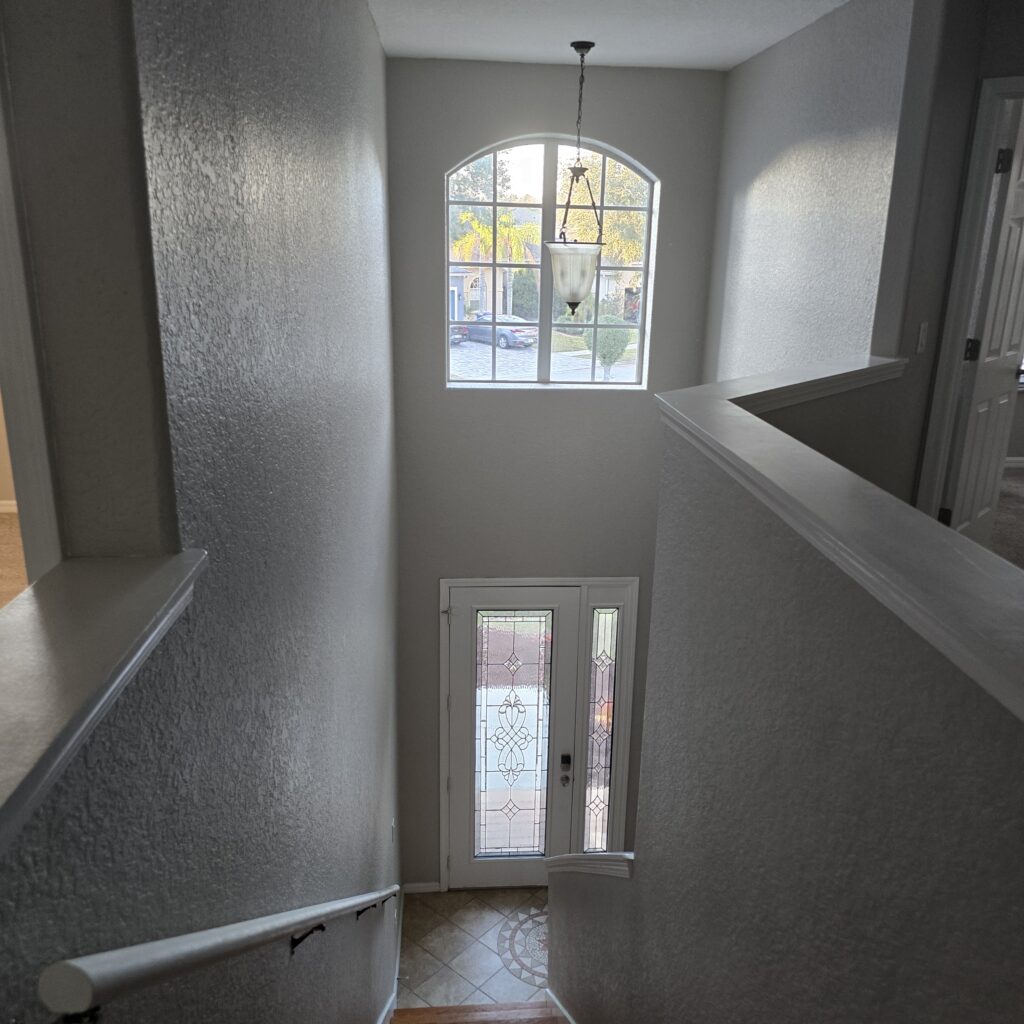
Stability is the cornerstone of safety in these environments. In many residential settings, the floor surface is not a raw concrete slab but a finished hardwood floor, plush carpet, or polished tile. These surfaces can be slippery or uneven, complicating the placement of ladders or lifts. Furthermore, the architecture itself often presents obstacles. We frequently encounter staircases that wrap around the area where the light needs to hang, or furniture that cannot be easily moved. Navigating these obstacles requires a strategic approach to ensure that the climbing equipment is perfectly stable before anyone sets foot on it. We often use stabilizers and levelers, and in many cases, a second team member is present solely to act as a spotter and ground support, ensuring the ladder or lift remains secure while the technician is aloft.
Fatigue is another subtle but dangerous factor in high installations. Working with your arms raised above your head is tiring on the ground, but doing so while balancing at height adds significant physical strain. Muscle fatigue can lead to a loss of grip strength or balance. Our team is trained to work efficiently but without rushing, taking necessary breaks to maintain peak physical control. We also utilize tool belts and hoisting systems effectively so that the technician does not have to carry heavy loads while climbing. By managing the physical demands of the climb, we reduce the risk of accidents caused by exhaustion or strain, ensuring that the focus remains entirely on the quality of the electrical work.
Specialized Equipment and Floor Protection
Standard extension ladders are rarely sufficient for high-end interior lighting installations. While they might reach the height, they often lack the stability required for a freestanding install in the middle of a room. To handle high ceilings safely, we rely on a fleet of specialized access equipment. This includes A-frame ladders that extend well beyond the typical twelve feet found in hardware stores, as well as scaffolding systems that can be erected to provide a stable, flat working platform. For extremely high or difficult-to-reach areas, we may employ compact personnel lifts that can fit through a standard doorway but extend upwards to reach the highest vaulted peaks. This equipment allows us to position the technician directly in front of the work area, rather than forcing them to reach dangerously to the side.
Need an interior lighting install? Click here for our interior lighting installation service.
Bringing heavy industrial equipment into a finished home requires a delicate touch. We treat your home with the utmost respect, which means protecting your flooring and furniture is as important as the installation itself. Before any ladder or scaffold is brought inside, we prepare the path and the work zone. This involves laying down heavy-duty drop cloths, runner mats, or even temporary hardboard flooring to prevent scratches, dents, or carpet stains. The feet of our ladders are inspected to ensure the rubber grips are intact and clean of debris that could mar a hardwood floor. If we are using a mechanical lift, we ensure the wheels are non-marking and that the weight of the machine is distributed safely to avoid damaging tile or stone work.
The logistics of maneuvering a large chandelier or fan to the ceiling also require specialized rigging. We do not rely on the electrician to carry a fifty-pound fixture up a ladder with one hand. Instead, we utilize motorized hoists or pulley systems designed to lift the fixture smoothly and controllably. This allows the technician at the top to focus on guiding the fixture into place and making the electrical connections without bearing the dead weight of the unit. This mechanical assistance is crucial for preventing damage to the fixture itself. A slip of the hand could send a crystal chandelier swinging into a wall or crashing to the floor. Our rigging protocols ensure that the fixture is supported independently until it is securely bolted to the ceiling box.
Structural Support and Electrical Box Integrity
One of the most critical, yet often unseen, aspects of a high ceiling install is the electrical box that supports the fixture. In many builder-grade homes, the standard box installed during construction is rated for a lightweight flush-mount light, not a heavy, multi-tier chandelier. If a homeowner attempts to hang a heavy fixture on a standard box, the weight can eventually pull the box loose from the joist, causing the fixture to fall. Before we even unpack the new light, we inspect the existing junction box to determine its weight rating and how it is secured to the framing of the house.
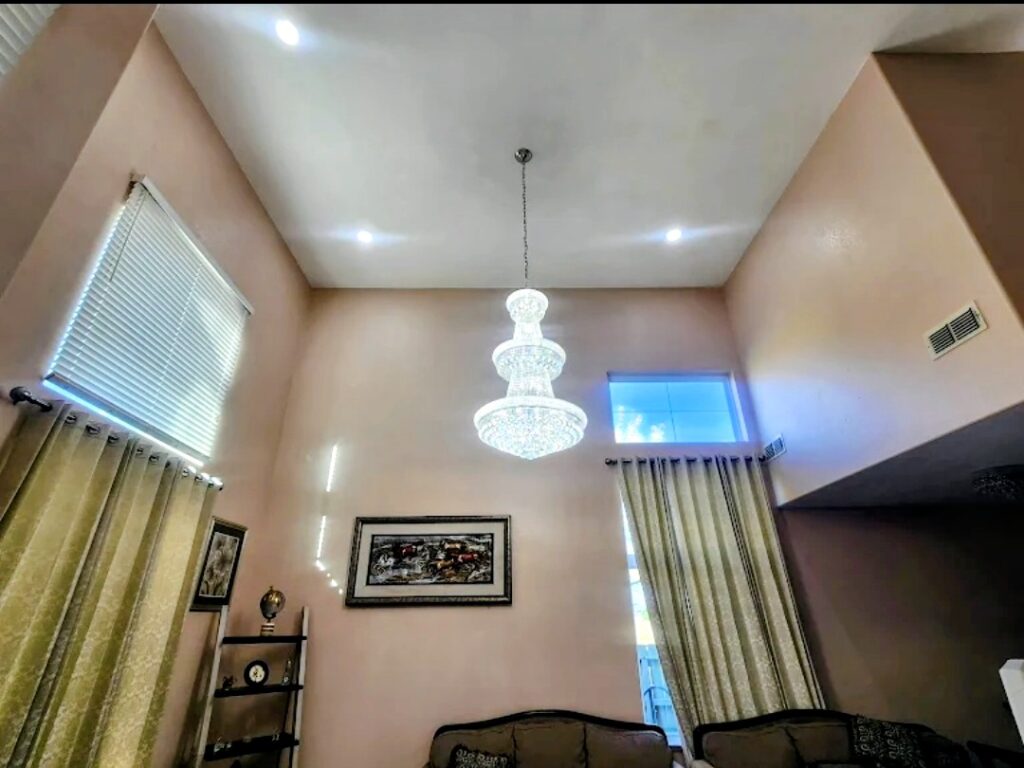
If the existing box is insufficient, which is often the case when upgrading to a larger statement piece, we must replace it. This can be challenging when the ceiling is finished and painted. We use specialized bracing systems that can be inserted through the existing hole in the drywall. These braces expand to span between two ceiling joists, biting into the wood to create a rock-solid anchor point that can support significantly more weight—often up to 150 pounds or more for fans and heavy chandeliers. This step ensures that the fixture is supported by the structure of the house, not just a patch of drywall.
Wiring at these heights also presents unique troubleshooting scenarios. In some cases, the heat accumulates at the peak of a cathedral ceiling, which can dry out the insulation on older wiring over decades. When we open the box, we inspect the condition of the existing conductors. If we find brittle or cracked insulation, we trim the wires back to healthy copper or use heat-shrink tubing to repair the insulation before making connections. We also ensure that the connections are made with high-quality wire nuts and secured with electrical tape as an added precaution. Because these fixtures are not easily accessible for maintenance, we take extra care to ensure every connection is tight and secure, minimizing the chance of a flickering light that would require another service call to fix.
Lighting Design and Maintenance Considerations
Lighting a room from twenty feet up is physically different from lighting a room with eight-foot ceilings. The inverse square law of light physics means that the further the light source is from the floor, the significantly less bright it will appear. A sixty-watt equivalent bulb that looks bright in a hallway will barely register from the top of a two-story foyer. We help homeowners understand the lumen output required to effectively light the space below. This often involves selecting fixtures with multiple bulbs or choosing bulbs with a higher lumen count. We also consider the directionality of the light; for high ceilings, fixtures that cast light downward are often more effective for general illumination than those that cast light upward, which might only illuminate the ceiling itself.
Want to know the benefits of LED lighting upgrades? Click here for more information.
Bulb selection is paramount for maintenance. The last thing you want is to hire an electrician to change a light bulb every six months. We almost exclusively recommend and install LED technology for high ceiling applications. LEDs have a lifespan of 15,000 to 50,000 hours, compared to the 1,000 to 2,000 hours of incandescent or halogen bulbs. This means your new fixture could go a decade or more without needing a bulb change. We also pay close attention to the color temperature of the LEDs. In a large, open space, a very cool white light can feel clinical or industrial, while a very warm light might feel too dim. We typically aim for a neutral, inviting 2700K to 3000K temperature that enhances the warmth of the home while providing ample visibility.
Beyond just the bulbs, we consider the cleaning and longevity of the fixture itself. Fixtures with open bowls that catch dust and dead insects can become unsightly quickly in a high location where they cannot be easily dusted. We often advise homeowners on fixture designs that are less prone to collecting debris or that have enclosed glass. When we install the fixture, we wear white gloves to handle crystals and glass shades, ensuring that we do not leave oily fingerprints that will attract dust. We want the fixture to look pristine from the moment we leave, and we want to help you select a design that stays looking that way with minimal intervention.
The Process: From Arrival to Clean Up
Our installation process is a choreographed routine designed to minimize disruption to your daily life. It begins with a site assessment, often done via photos or a preliminary visit, to determine the height of the ceiling and the specific access challenges. On the day of the install, our team arrives with the specific ladder or lift required for the job. We clear the area of moveable furniture and lay down our floor protection immediately. We then assemble the new fixture on the ground. Large chandeliers often come in dozens of pieces to prevent damage during shipping. We meticulously assemble the frame, wire the arms, and install the bulbs while the unit is still accessible on the floor, testing the circuit to ensure everything works before it goes up in the air.
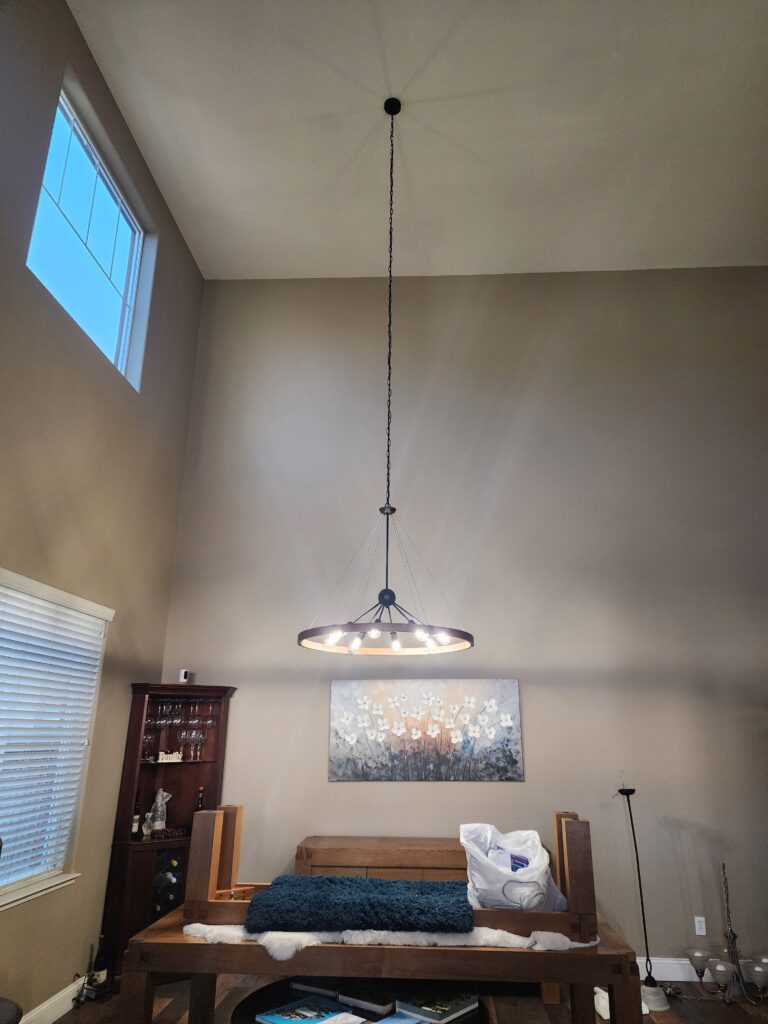
Once the prep work is done, the ascent begins. We remove the old fixture, carefully lowering it to the ground for disposal or storage. We then prep the ceiling box, installing any necessary structural bracing. The new fixture is hoisted up, supported, and wired. We pay particular attention to the chain or suspension cable length. Getting the height right is crucial for aesthetics; a chandelier that hangs too high looks awkward, while one that hangs too low can obstruct views or walkways. We work with you to determine the perfect drop height before finalizing the mount. Once the canopy is secured against the ceiling, we do a final check of the balance. A crooked chandelier is immediately noticeable, so we adjust the chain links or mounting bracket until the fixture hangs perfectly plumb.
The final step is the cleanup and reveal. We remove the protective coverings, vacuum any drywall dust that may have fallen during the installation, and move your furniture back into place. We take the packaging materials and the old fixture with us, leaving your home exactly as we found it, save for the stunning new light overhead. We then demonstrate the operation of the light, including any new dimmer switches we may have installed. High-end fixtures often benefit from dimmers to control the ambiance, allowing you to go from full brightness for cleaning to a soft glow for evening entertaining. We ensure you are comfortable with the controls before we consider the job complete.
A high ceiling light installation is one of the most transformative upgrades you can make to your home. It turns a vast, empty volume of space into a warm, illuminated, and sophisticated feature. However, the complexity and danger associated with these heights make it a project that sits firmly outside the realm of DIY. The combination of ladders, heavy fixtures, and electrical wiring creates a trifecta of risks that are best managed by experienced professionals with the right tools and training.
At Frayer Electric, we take pride in our ability to handle these challenging installs with precision and care. We bring the scaffolding, the experience, and the steady hands needed to elevate your home’s lighting safely. We ensure that your fixture is supported structurally, wired correctly, and positioned perfectly to enhance the beauty of your room. Don’t risk a fall or a faulty install.